


Rutgers Women’s Brain Health Initiative
Empowering Women’s Brain Health Across the Lifespan
Empowering Women’s Brain Health Across the Lifespan
Women experience unique biological transitions—puberty, pregnancy, motherhood, menopause, and aging—that shape brain health in ways science has long overlooked. For decades, medical research excluded females. The result: major gaps in understanding conditions that disproportionately affect women.
The Rutgers Women’s Brain Health Initiative (RWBHI), a new effort of the Rutgers Brain Health Institute (BHI)—one of the world’s largest and most comprehensive brain research organizations—closes that gap. We support research that directly addresses women’s brain health and deliver research-backed information the public can use.
Join us. Together we will:
- Feature Rutgers faculty advancing research on the female brain
- Host world-renowned speakers leading the field
- Provide research-vetted toolkits and resources
- Host a day-long symposium on the female brain and women’s brain health — Save the date: May 26, 2027
Which area of women’s brain health matters most to you? Vote in our poll.
Why Women’s Brain Health Matters
Women make up half the world’s population and live longer than men—yet they carry a heavier burden of neurological and mental health disorders. Women are more likely to develop Alzheimer’s disease, depression, migraine, anxiety, PTSD, eating disorders, and chronic pain. They also show greater resilience to stroke, traumatic brain injury, and Parkinson’s. Understanding the biological basis of both vulnerability and resilience benefits everyone.
These biological differences are compounded by systemic healthcare barriers. Landmark research from the July 2025 Gallup and Pivotal survey of 5,232 U.S. adults (including 3,845 women) reveals the stark reality:
- Healthcare access and experiences
- 51% of women reported at least one negative healthcare experience in the past five years (symptoms dismissed or misdiagnosed), vs. 39% of men
- 32% skipped or delayed needed care due to cost; 30% had to push to be taken seriously
- Critical life stages
- Pregnancy & postpartum: 54% of women who gave birth in the past 20 years experienced a mental health challenge; only 29% who sought care found it very helpful
- Menopause: Nearly three-quarters of women aged 45–54 report symptoms, yet 37% only learn about them when they begin
- Broader impacts
- Poor health and barriers affect family life or relationships for 54% of women, work or careers for 42%, and community participation for 32%—with disproportionate effects on lower-income and Black and Hispanic women.
Americans strongly support change: 82% prioritize safe pregnancies and 81% prioritize quality healthcare access as high or top national priorities.
Understanding. Empowering. Thriving.
RWBHI addresses the knowledge gap by showcasing research on brain health challenges that disproportionately affect women—from basic cellular and animal studies to human clinical work. We translate findings into clear, trustworthy, actionable information for women and families.
Our goals:
- Support research that solves the brain health issues women face
- Bridge the gap by moving discoveries from lab to community across the lifespan
- Empower decisions with research-backed knowledge for proactive brain health choices
- Drive awareness of how female biology’s extraordinary transitions shape brain health
Menopause: A Key Transition in Women’s Brain Health
Menopause is much more than the end of menstruation—it is a major hormonal shift that can profoundly impact brain health, cognition, mood, and sleep. Through RWBHI, we are committed to advancing targeted research, education, and clinical support for this universal transition and its lifelong impact on women’s well-being.
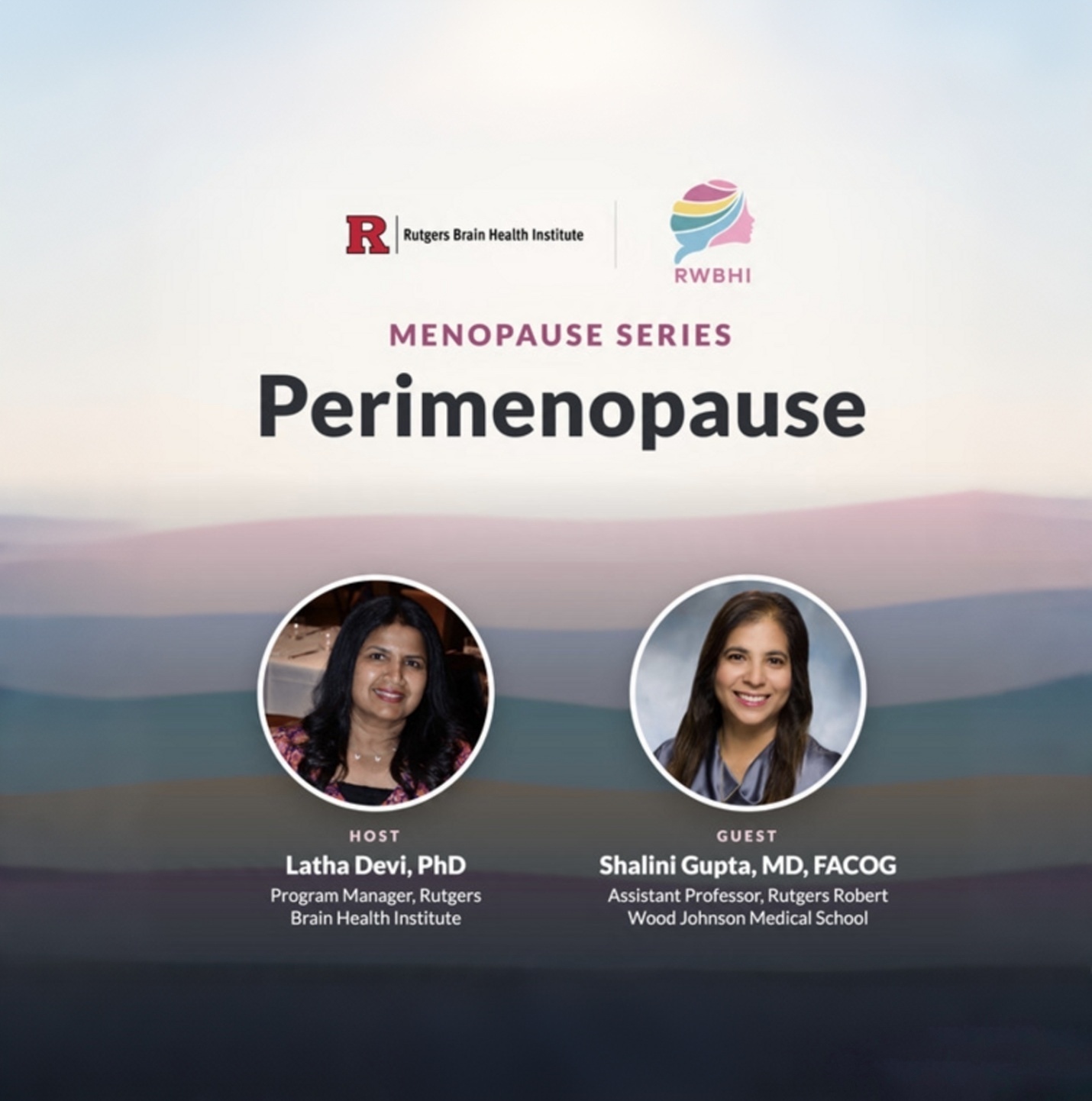
Perimenopause: Recognition, Treatment, and Maintaining Health
This article is the first in our new series from the RWBHI exploring the key topics in menopause and women’s health in midlife. We covered the practical questions many women and clinicians face during the menopausal transition-starting with recognition, diagnosis, and evidence -based management of common symptoms.
Dr. Shalini Gupta, a board-certified obstetrician-gynecologist, assistant professor at Rutgers Robert Wood Johnson Medical School, and Menopause Society Certified Practitioner, speaks with Dr. Latha Devi of the BHI about recognizing symptoms and navigating care in this episode.



BHI Toolkits
Discover Rutgers Brain Health Institute Toolkits, offering evidence-based resources to support brain health, emotional resilience, and mental wellness for everyday life and challenging times. Developed by the BHI, these practical guides address seasonal mood shifts, post-holiday adjustment, mental health challenges, and more using insights from cutting-edge neuroscience.
Leading RWBHI
Dr. Ioana Carcea, MD, PhD, Associate Professor at the Rutgers Brain Health Institute and New Jersey Medical School, leads RWBHI. Her lab uses systems neuroscience to study how biological states and social experiences shape health and brain function, with a focus on maternal behavior and related transitions.

“Women’s physiology poses unique challenges to brain function and behavior. Across puberty, pregnancy, and menopause, the female brain undergoes extraordinary biological transitions that shape vulnerability and resilience to mental and neurological disorders,” said Dr. Carcea. “Now we have the tools, the knowledge, and the will to understand how the female brain navigates multiple profound transitions across the lifespan. I am excited for the Rutgers WBHI to be at the forefront of this emerging area of research.”
Support the Rutgers Women’s Brain Health Initiative
The Rutgers Women’s Brain Health Initiative (RWBHI) is dedicated to addressing the knowledge gap in women’s brain health by showcasing research on brain health problems that prominently affect women. We aim to deliver clear, trustworthy, and research-vetted actionable information that will directly benefit women and their families.
