

Prenatal Extracellular Vesicles and Autism Risk: How Maternal–Fetal Signals May Shape Development

Public interest in potential causes of autism is understandably high. Families want answers that are clear and evidence-based. Science is moving in that direction, but one message remains consistent: autism does not have a single cause. Instead, autism reflects a complex interaction of genetics, biology, and environment across early development.
One of the most important frontiers in the field of autism research is studying early risk factors that emerge during pregnancy. The prenatal period is a time when the brain is developing at extraordinary speed, and the fetus is continually receiving biological signals from the mother via the placenta. Researchers have long studied pathways of maternal-fetal communication through hormones, inflammation, nutrition, and the microbiome. Now, a growing body of work is focusing on another form of communication, extracellular vesicles.
At Rutgers, Morgan Firestein, PhD, an Assistant Professor in Pediatrics and Resident Scientist at the Child Health Institute of New Jersey at Robert Wood Johnson Medical School and a member of the Brain Health Institute community, is investigating a less-studied prenatal signaling system that may help explain why certain prenatal conditions are linked to higher neurodevelopmental risk and why many children remain resilient.
What we know about autism risk and resilience
When people ask what causes autism, they often hope for a single culprit. That is not how the evidence looks. Rather, genetics plays a major role, but emerging research supports the idea that prenatal and early-life factors can contribute to the pathogenesis of autism, especially when they occur during sensitive periods of brain development. Fortunately, research also suggests that risk is not destiny. Many children exposed to prenatal risk factors do not develop autism.
Through cohort studies that evaluate the association between various prenatal risk factors and autism, researchers are able to map risk pathways (what raises the odds) and resilience pathways (what protects development even in the presence of risk). Firestein’s work sits squarely in that space.
The fetal environment is not passive—it’s information-rich
The womb is not just a physical space. It is a dynamic environment where maternal biology and fetal development are in constant interaction. This is often called the intrauterine environment, and it includes many channels of maternal–fetal signaling, such as hormones and stress biology, immune signals and inflammation, maternal and fetal autonomic nervous system activity, nutrition and metabolism, and microbial exposures. Firestein’s lab focuses on one additional pathway that has received less attention in neurodevelopment research: extracellular vesicles.
Extracellular vesicles: tiny “packages” with biological information
Extracellular vesicles (often shortened to EVs) are small particles released by cells throughout the body and are taken up by recipient cells. You can think of them as biological delivery packages that travel through the bloodstream carrying cargo such as pieces of genetic material (RNA,microRNA, and long non-coding RNA), proteins, and other molecular signals that can influence how recipient cells behave
EVs are now recognized as a mechanism of maternal–fetal communication. Evidence suggests EVs can cross the placenta, and certain types—especially exosomes (a smaller class of EVs)—may also cross the blood–brain barrier.
That creates a compelling hypothesis: if pregnancy-related conditions change the amount or “cargo” of EVs, those changes could influence developing brain systems, or provide an early readout of what the fetus is experiencing biologically.
Several gestational conditions, such as gestational diabetes mellitus and hypertensive disorders of pregnancy, are consistently associated with increased neurodevelopmental risk in children, including elevated risk for autism-related outcomes.
These conditions are also associated, in other lines of research, with changes in EV concentrations and EV cargo. What has been less clear is whether EV changes during pregnancy relate to later child neurodevelopmental outcomes.
Firestein’s work helps connect those dots.
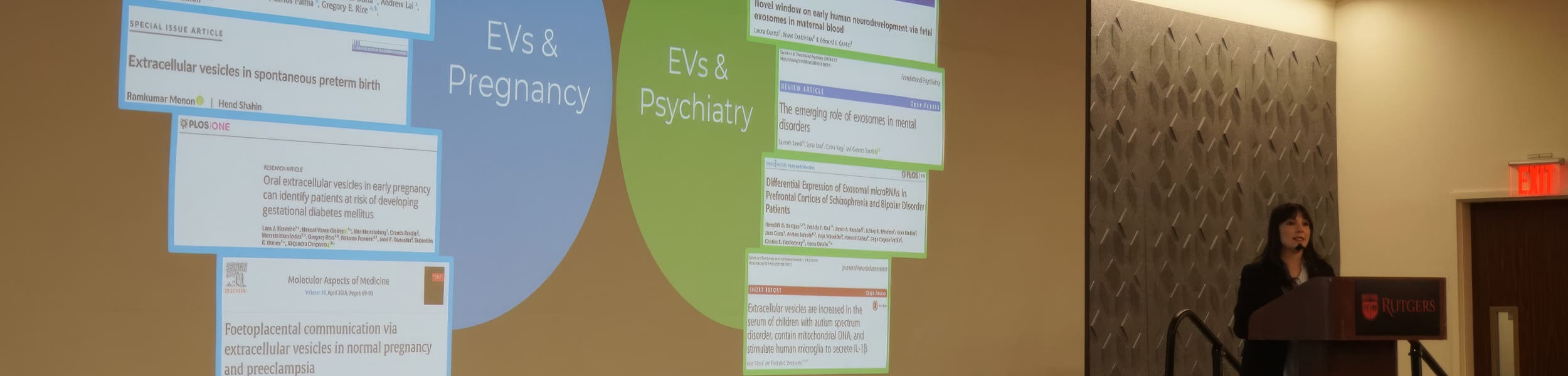
A key research question: can prenatal EVs function as early biomarkers?
A major goal of Firestein’s research is to determine whether EVs in maternal blood during pregnancy can serve as:
- biomarkers (early measurable signals associated with later outcomes), and/or
- mechanistic clues (signals that point to biological pathways shaping development)
This is a critical distinction. A biomarker does not need to be the cause of a condition. It can be an early indicator that helps researchers identify risk pathways sooner, study them more precisely, and eventually improve therapeutic targets and expedite access to intervention services
What the early findings suggest
In a large, national cohort of pregnancies (with maternal samples collected during pregnancy and children followed for early developmental assessment), Firestein’s team examined EVs from maternal plasma collected in the second trimester.
Children were evaluated at age 4-6 years using parent-report tools that screen for autism-related risk and broader neurodevelopmental concerns (screening tools are not diagnostic). Children meeting an at-risk cutoff on at least one measure were categorized as “high-risk” for the purposes of the study and matched to a lower-risk comparison group on factors like gestational age, age at assessment, and sex.
The pattern that emerged was notable: mothers of children in the higher-risk group had higher EV levels in the second trimester, though with substantial variability.
That variability is not a weakness—it is the point. It highlights why the field must study not only risk, but also resilience: why some children appear unaffected even when an early biological signal is elevated.
Firestein’s group also used RNA sequencing approaches to examine EV cargo and found differences in expression patterns between groups. One emerging target of interest is VGF, a gene with strong expression in brain regions involved in metabolism and hormone-related regulation—systems increasingly recognized as relevant to neurodevelopment.
At this stage of the research, Dr. Firestein is hoping to identify new small or long non-coding RNAs that could point to a mechanism involved in autism etiology. Long-term, EVs may offer a way to study prenatal development through a noninvasive blood sample, potentially revealing biological pathways linked to metabolism, inflammation, or other systems that influence brain development.
What’s next:
The next phase of Firestein’s research will include a new prospective cohort of pregnant people with gestational diabetes or hypertensive disorders, alongside matched healthy controls.
In this next study, EVs will be sampled later in pregnancy (around 32–35 weeks and again at delivery) and infants will receive neurodevelopmental assessments beginning at six months of age.
One of the most innovative aspects of this work is the ability to isolate EVs that originate from specific sources.
Firestein noted that a meaningful portion of EVs found in maternal blood may be placental in origin, and that it may be possible to go further—isolating EVs that originate from the fetal brain.
If validated, this could create an unusually informative “window” into prenatal brain-related signaling by leveraging maternal blood samples. To understand mechanisms through which placental EVs might impact the brain, Firestein’s lab is also developing protocols to co-culture EVs from the placenta with developing neural cells, including neural progenitor cells and microglia, to examine whether EVs induce measurable transcriptional and inflammatory changes.
This kind of experiment moves the field by expanding upon associative findings to examine more direct, mechanistic questions.
Make A Difference
Become part of our mission to revolutionize neuroscience. Whether you’re a researcher, clinician, or supporter, your involvement can help shape the future of brain health.
